










Ethnic Surface Patterns: Origins and Current Trends
An invitation to travel without moving, ethnic patterns speak to our desire to get away. For several decades, tribal-inspired graphics or folkloric textile patterns have brought their distinctive elegance to fashion and home decor. They embody a people’s identity and reflect aesthetic values shared by all of humanity. Printed, woven, or embroidered, ethnic textile design celebrates the cultures of the world and elevates their differences. Ready for a change of scenery ? Follow the guide !
What is an ethnic pattern ?
The term “ ethnic ” generally describes a decor element or design drawn from traditional craftsmanship of a people sharing the same language and the same culture . In the Western world, the repertoire of “ ethnic patterns ” encompasses many graphic creations from elsewhere. This “ elsewhere ” is not always outside the European continent, however: certain folkloric surface patterns rooted in Europe’s folk arts and traditions also belong to the repertoire of ethnic patterns.
In absolute terms, an ethnic pattern can be geometric , figurative or symbolic . Its defining feature is less a precise geographic origin than, above all, a strong cultural anchor . These personality-rich designs may originate in North or Sub-Saharan Africa, India, pre-Columbian America, Southeast Asia, or Scandinavia, created by Indigenous peoples of the Americas or Oceania… They find expression through textiles, ceramics, body painting, jewelry, or everyday objects.
Far from being reduced to productions with exotic charm, they often represent a fully fledged mode of expression. They are not characterized only by their bright or warm colors, but also by their meaning. As distinctive signs of belonging to a given social group, closely tied to folk traditions, they can thus tell a story, be imbued with spirituality , or even be considered protective .
By extension, the term has become generic. It also applies to all kinds of creations inspired by this vast global repertoire, raising along the way the delicate question of cultural appropriation.
Ethnic patterns in contemporary fashion
For several decades, ethnic patterns have regularly appeared in trends and enriched collections. The “ ethnic ” phenomenon emerged in Western fashion in the late sixties , driven by a counterculture in search of authenticity that championed openness to the world. Wardrobes then filled up with prints inspired by African, Indian, or South American traditions.
Having become chic, ethnic style has taken hold, and fashion today gives pride of place to these designs—ambassadors of cultural diversity. Wax , ikat , Native American symbols and Aztec weaves appear in printed dresses, embroidered jackets, scarves, or bags. Valued for their stylistic originality, these clothes and accessories win people over thanks to the touches of color and personality they bring to an outfit.
Ethnic patterns in art
From the beginning of the 20th century, Western artists were fascinated by “ primitive ” arts from Africa and Oceania. Picasso , Matisse or Klee , to name just a few, upended so-called “ classical ” painting by drawing new creative energy from artistic forms of expression from faraway lands.
This momentum continues today thanks to the work of several contemporary artists who choose to integrate ethnic patterns at the heart of their work in order to question colonial history and cultural identities. These symbols can be highlighted as they are, freely reinterpreted, or merged with other graphic elements. Above all, they are far from fixed, as demonstrated by current artists such as Max Tetar or Barthélémy Toguo who develop their own graphic style, at the crossroads of cultures.
For many creators from a diaspora , they are a way to reaffirm their heritage and display it for the world to see. For others, it is a way to assert their own aesthetic , to create painting rituals, to explore the possibilities of spontaneous, instinctive gestures...
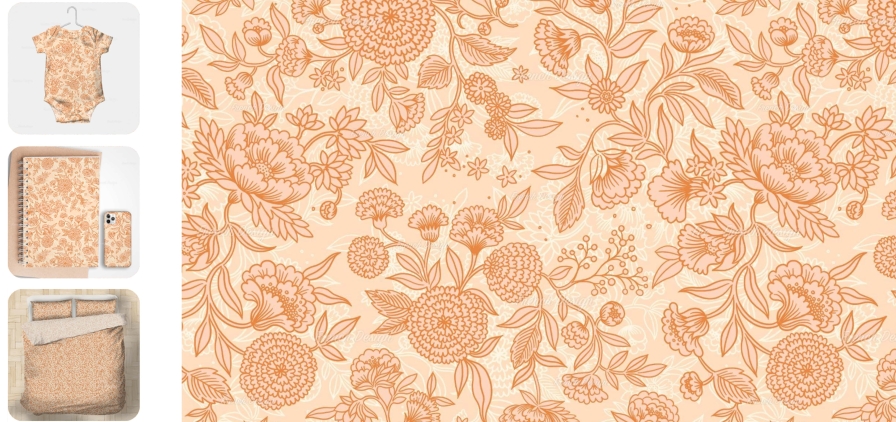
"PINK MARIGOLD" pattern created by La Main au Coeur - pattern design, textile designer on French Design by Textile Addict
Different types of ethnic patterns
They are emblematic, almost classic, or simply in step with the times. Their bohemian spirit or tribal vibe can create warm atmospheres , exotic and original in interior design, or energize a collection of printed fabric intended for ready-to-wear. Let’s embark on an overview of the most inspiring and most on-trend ethnic patterns.
Turkish kilims : symbolic geometry
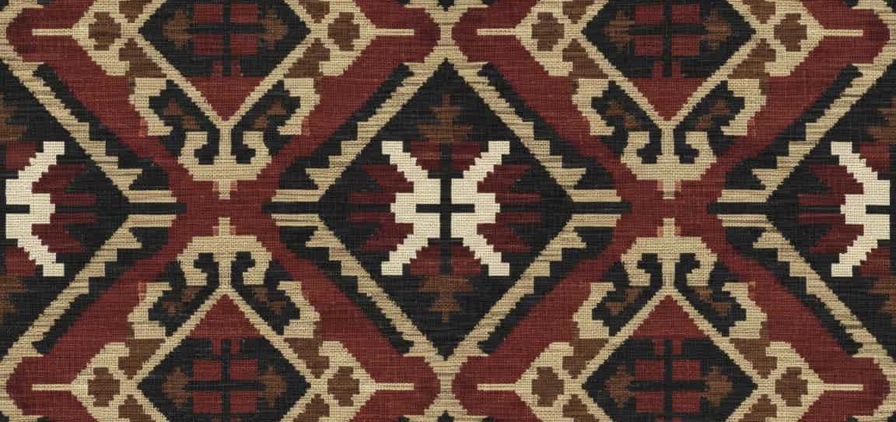
In Turkey, but also in certain regions of the Middle East and Central Asia, the art of the Kilim is cultivated. These traditional woven rugs stand out for their highly codified geometric textile designs (squares, rectangles, hexagons, stars, octagons, diamonds...) comparable to a form of symbolic writing. They also incorporate animals in relatively figurative or highly stylized forms, sometimes reduced to a single detail (claws or bird wings, a wolf’s muzzle, ram’s horns…) The shapes are angular and repetitive, sometimes bordered with friezes and rendered in bright or natural colors that reinforce their graphic look (red, brown, beige, black…) Each design has its meaning, symbolizing strength, fertility, the aspiration to happiness, protection...
Indian ethnic patterns : complexity and spirituality
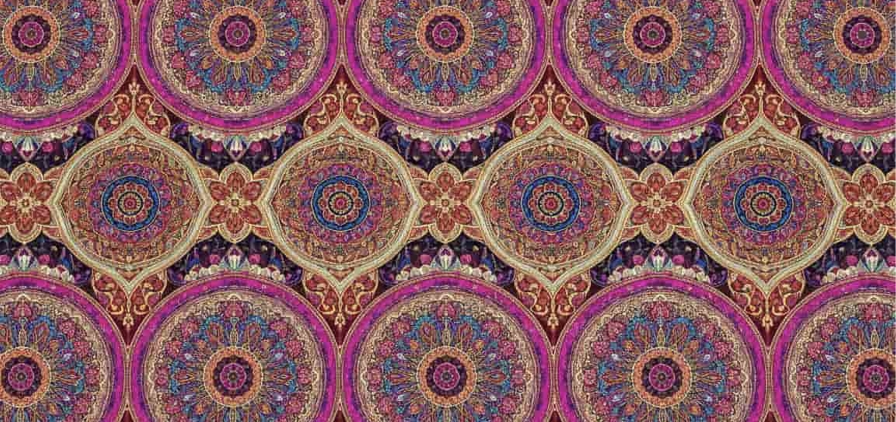
India is a land of patterns and spirituality. The sacred is omnipresent there, embodied by recurring symbols with curved, refined shapes . Designs are everywhere, on fabric but also in architecture, in the form of abundant flowers and foliage , hypnotic mandalas symbolizing the universe, animal representations (elephants, peacocks..) or deities . The sari, a traditional garment, is adorned with designs dyed using the batik technique , or woven in shimmering brocade.
African ethnic patterns : strength, rhythm, and symbolism
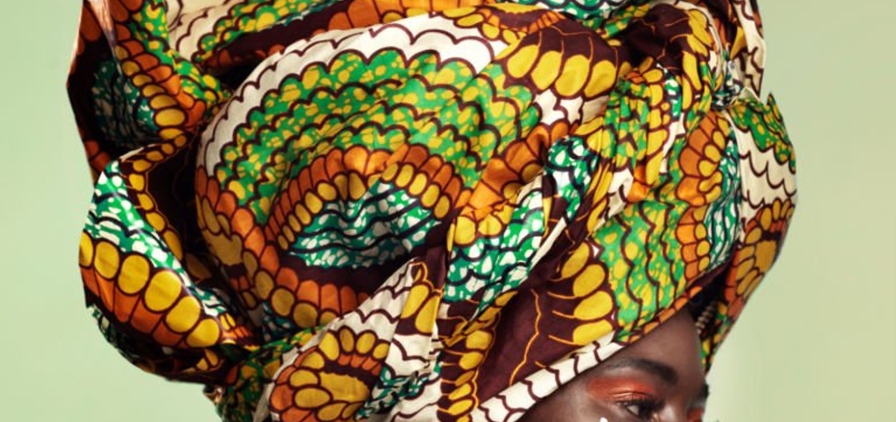
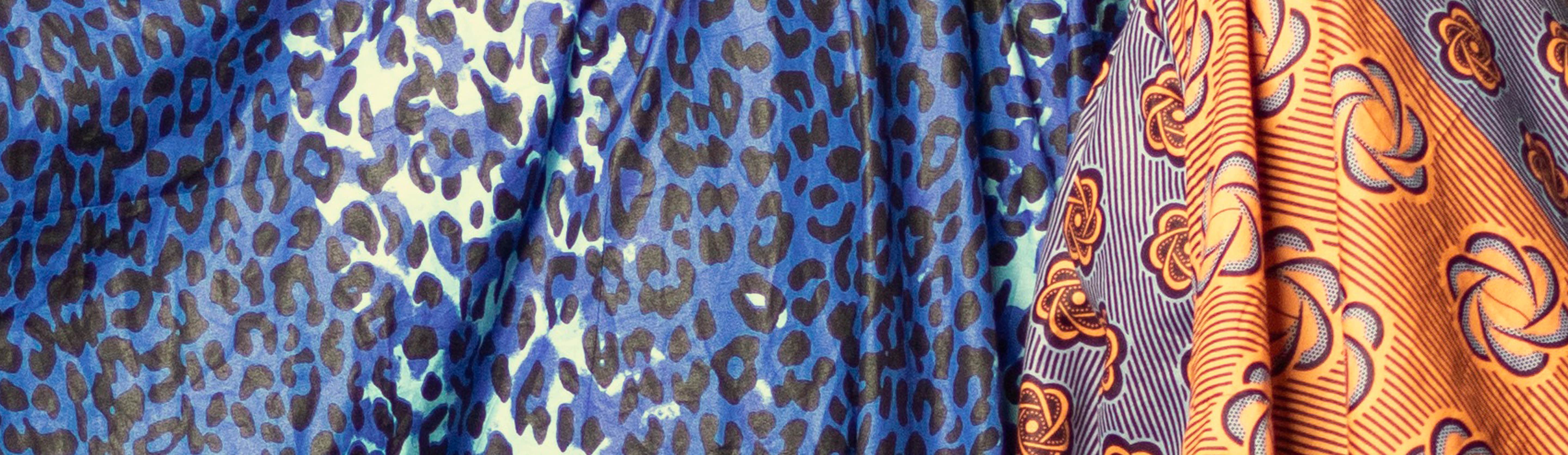
Africa’s memory rests on oral traditions, but also on graphic ones. The traditional seamless patterns of the many African ethnic groups can be found on cotton fabrics (Wax, Bogolan, Kikoï, Kente…) as well as on sculptures, murals and jewelry . Comparable to a language expressing collective identity as well as individual identity, these symbolic textile patterns can evoke words of wisdom, proverbs, myths, or even social statuses. The shapes are often geometric , dynamic , combined into visually rhythmic compositions, supported by bright and contrasting colors.
Persian textile patterns
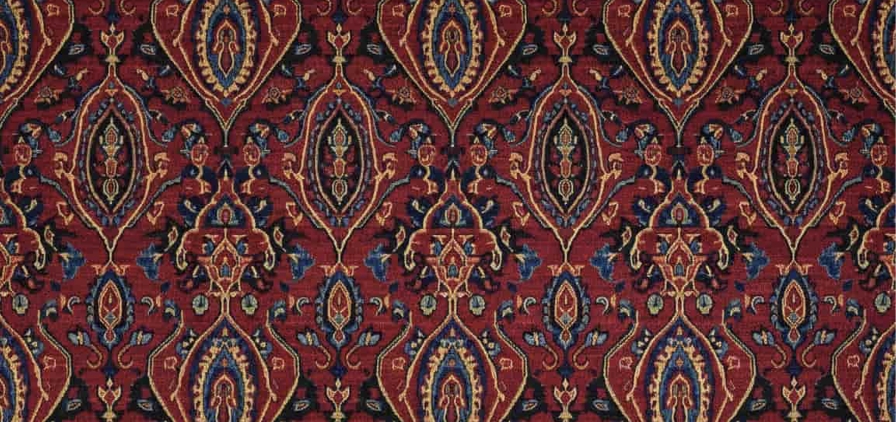
Rich in traditional designs, Persian art abounds in ornamental elements depicted on textiles , rugs or ceramics . The best known are the arabesque surface patterns , palmettes and Boteh (“ bouquet of flowers ” in Persian), which symbolizes love. The latter is also called the Kashmir semaless patterns or Paisley, and its teardrop shape is inspired by the famous Chinese Yin and Yang symbol.
Native American seamless patterns
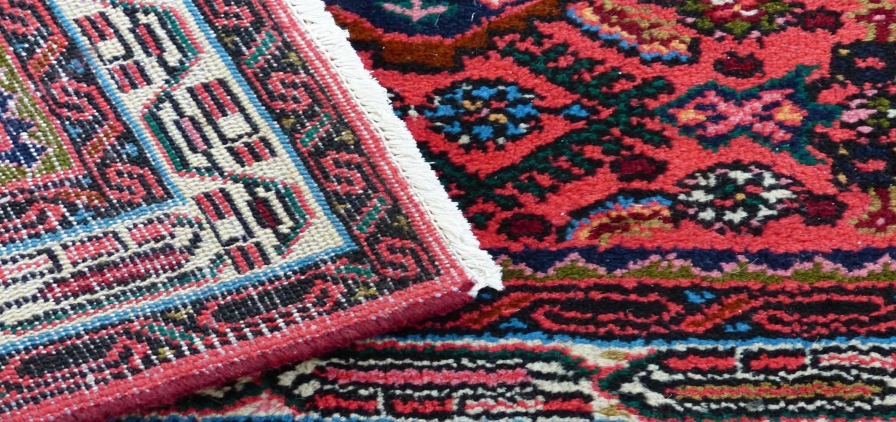
From North to South, there is great aesthetic diversity in the textile arts of Indigenous peoples of the Americas. In the Andes, for example, the textiles of the Quechua or Aymara peoples bear witness to pre-Columbian heritage. Zigzags, diamonds and stylized animals (llamas, condors, snakes…) in multicolored wool form a visual language filled with ritual or historical meanings, linked to ancient Inca beliefs. In Mexico , floral textile patterns are embroidered in shimmering colors , sometimes revealing patterns of plants, foliage, and animals (birds, reptiles, insects...)
Asian textile patterns : delicacy and stylized nature
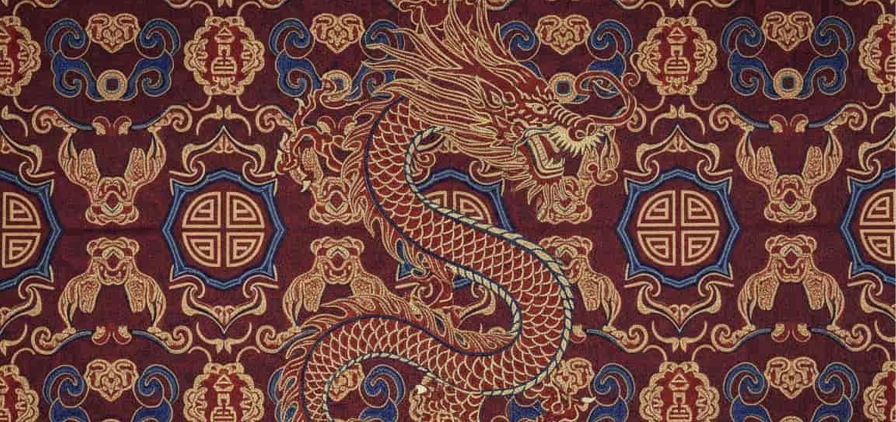
In Asia, traditional seamless patterns reflect close attention to nature. Often inspired by the elements, they carry symbols or wishes such as longevity, prosperity, good luck, or wisdom. In China , the dragon , the phoenix and the cloud are frequently depicted in embroidery and porcelain. In Japan, a sense of harmony and geometry is expressed through wagara designs that are understated and refined , Japanese textile patterns are inspired by waves ( seigaiha ), hemp leaves ( asanoha ) or the tortoise shell ( kikko ).
Black-and-white ethnic patterns
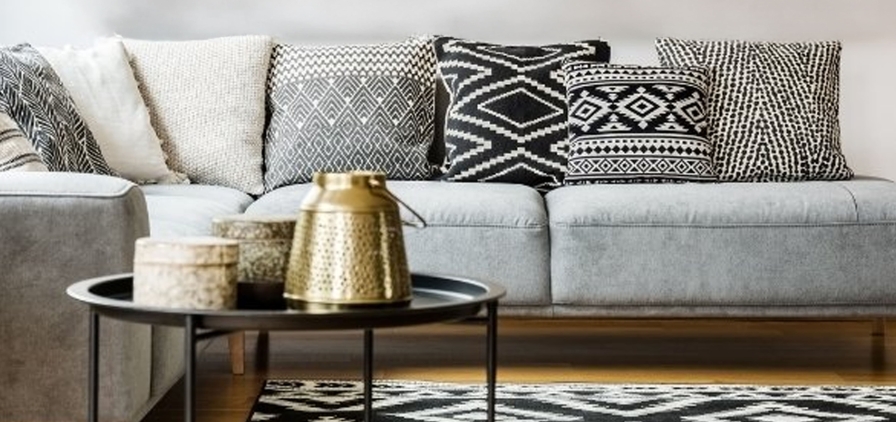
Not all ethnic patterns necessarily wear multicolored hues—some instead play on black-and-white contrast. The absence of color also helps underscore the authenticity of the design, its graphic strength, and its details. Often composed of symbolic or highly expressive geometric shapes , black-and-white ethnic patterns are a beautiful way to highlight their dynamism and timeless elegance.
Scandinavian / Nordic ethnic patterns
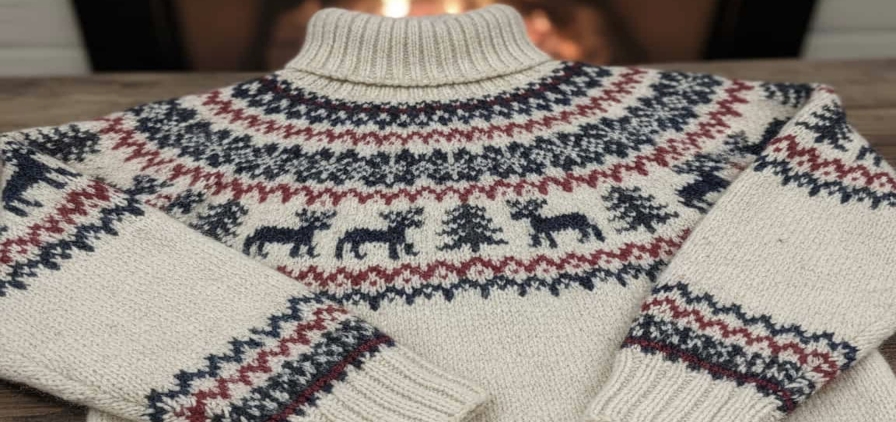
Scandinavian textile and surface patterns—often called Nordic designs—are a set of geometric designs deeply rooted in the textile history of Norway, Sweden, Denmark, Iceland, and Finland. They are found on wool fabric, cotton, canvas, and clothing. Their geometric style stands out through clean lines, symmetrical shapes and illustrations inspired by Nordic nature . Common patterns include snowflakes , eight-point stars , stylized fir trees, reindeer, and abstract shapes that create regular repeats . This visual structure gives each design a highly legible, almost iconic look.
General characteristics of Scandinavian patterns
- dominance of white , black , red and blue on a contrasting background;
- simple geometric seamless patterns ;
- a clean style typical of Nordic art;
- a strong presence in knitting, sewing, and home decor;
Scandinavian textile designs are especially used for winter fabrics , sweaters , blankets , and decorative illustrations . This type of ethnic textile pattern is also common in year-end holiday decorations, because it often pairs bright colors like red and white.
Common examples of Nordic patterns
|
Pattern type |
Typical colors |
|---|---|
|
Snowflakes |
White / red / black |
|
Stars |
White / blue |
|
Fir trees |
Green / white |
|
Reindeer |
Black / red |
Maori ethnic pattern
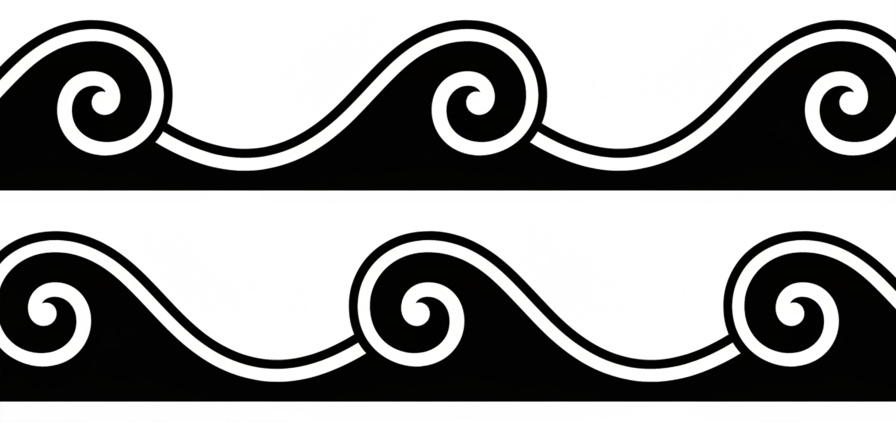
Maori patterns — originating from the indigenous culture of New Zealand — form an extremely codified graphic tradition. They are particularly well known through the art of ta moko tattooing and kirituhi , a type of tattoo inspired by Maori tribal style but intended for non-Maori people. These ethnic patterns have been present for centuries in carving, the ornamentation of traditional houses (wharenui), textiles, ceremonial weapons, and various ritual objects.
The Maori style is based on curvilinear designs that are deeply geometric , built from spirals , scrolls , hooks and repeated lines . This pattern forms a visual language of identity symbols. Maori art is distinguished by a fluid rather than rectilinear geometry , which gives it a highly abstract and organic appearance. Maori patterns are often drawn in black on a light background, particularly in tattooing, or appear carved in wood.
Recognized Maori symbols
Among the most well-known designs, the koru holds an essential place. Inspired by the unfurling young fern frond, it evokes the momentum of life, waves, natural forces, and sometimes even family members. The koiri takes the shape of the koru but repeats and folds it onto itself, creating a succession of arcs that symbolize growth and benevolence. The mangōpare , representing the hammerhead shark, is associated with strength and courage. As for the puhoro , it is a dynamic variation of the koru divided into rapid points, often linked to the idea of speed, storms, or movement.
Other textile patterns also play an important role: the pātiki , inspired by the flatfish (flounder), evokes abundance and generosity, while the ngaru represents ocean waves and recalls the journey of Maori ancestors who arrived in New Zealand aboard their waka. The kōwhai ngutukākā , a floral textile pattern derived from the “kākā beak” plant, appears in many ornaments. The rauru , close to the koru spiral, also refers to growth and calmness. Finally, the ngutukākā or marama seamless pattern may represent the beak of the kākā or the Moon depending on the context, demonstrating the symbolic richness of Maori art.
Summary Table of Māori textile patterns
|
Textile pattern |
General Meaning |
Represented Element |
|---|---|---|
Koru |
New life, energy, family |
Fern frond |
Kōiri |
Growth, introspection |
Repeated koru |
Mangōpare |
Courage, strength |
Hammerhead shark |
Puhoro |
Speed, movement |
Split koru |
Pātiki |
Abundance, hospitality |
Flounder (fish) |
Ngaru |
Journey, ocean |
Waves |
Kōwhai Ngutukākā |
Importance of women |
Kākā beak plant |
Rauru |
Growth, peace |
Spiral |
The role of the Māori textile pattern in tattooing (Tā Moko and tribal tattooing)
Tattooing holds an absolutely fundamental place in Māori culture. Tā moko is not considered a simple drawing but an identity marker. The Māori textile patterns used in these tattoos are directly inspired by traditional forms. On the skin, these geometric lines create a highly recognizable visual language, where each textile pattern serves as a meaning-bearing icon.
Since the 1990s, tribal aesthetics have gained visibility in global fashion. Certain celebrities have helped popularize these textile patterns, while paying tribute to their roots or their cultural heritage. Dwayne Johnson (The Rock) wears a traditional Polynesian tattoo created according to the codes of his Samoan culture, several elements of which can be related to Māori textile patterns through their spirals and repetitive lines. Jason Momoa , also of Hawaiian origin, displays a tattoo inspired by his Aumakua tribe, sharing certain stylistic characteristics with Māori geometric patterns.
Today, tribal textile patterns frequently appear in contemporary tattoos. Many studios draw inspiration from the curved lines of the koru or the chevrons of the puhoro to create abstract designs. However, true tā moko remains deeply tied to Māori culture and must be performed by trained artists, with respect for its traditional meaning. Modern tribal tattooing, on the other hand, adopts certain aesthetic codes — geometric textile patterns, repetition, black contrast on a light background — without retaining the identity-based dimension.
Summary Table of Different Types of Ethnic Textile Patterns
|
Ethnic / Tribal Seamless Pattern Type |
Main Characteristics |
|---|---|
Turkish Kilim Textile Patterns |
Codified geometric seamless patterns (squares, diamonds, stars, octagons), stylized animals (bird wings, ram horns), borders, symbolic elements (strength, fertility, protection). Red / brown / beige / black colors. |
Indian Ethnic Textile Patterns |
Sacred illustrations, refined curved textile patterns, mandalas, floral designs, colorful style, commonly found in clothing. |
African Ethnic seamless patterns |
Dynamic, tribal, geometric African textile patterns, bright and contrasting colors, symbolic designs on cotton fabrics (Wax, Bogolan, Kikoi, Kente). |
Persian surface patterns |
Refined ornamental designs: arabesques, palmettes, boteh, abstract and floral style. |
Native American textile patterns |
Geometric seamless patterns (zigzags, diamonds), abstract and colorful designs, multicolored wool textiles. |
Asian designs |
Nature-inspired designs: dragon, phoenix, clouds, waves, hemp leaves, turtle shell, geometric design. |
Black and White Ethnic textile patterns |
Highly expressive symbolic or geometric shapes. |
Scandinavian / Nordic designs |
Symmetrical geometric textile patterns: snowflakes, stars, fir trees, reindeer; white / black / red / blue colors; clean design. |
Māori seamless patterns |
Curved designs, repeated lines, tribal style, identity surface patterns (koru, kōiri, mangōpare). |
This brief inventory represents only a tiny fraction of a vast repertoire illustrating humanity’s creativity and the deep attachment of ancient peoples to their roots.
Beyond trends, caricatures, and debates, ethnic textile patterns remind us that art has no borders. On the contrary, its evolution—like that of fashion or interior design—largely results from intercultural influences. This immense family of textile patterns holds a precious collective memory and constitutes an inexhaustible source of inspiration for creators from all backgrounds. Capturing their essence, their universality, and reinterpreting them with respect requires undeniable talent—talent that can be found in the “World culture” French Design textile pattern collection.