










Toiles de Jouy: iconic designs
For nearly four centuries, toile de Jouy has been telling elegant stories on fabric. Unfolding pastoral scenes and bucolic landscapes in a style unique to its kind, it has the astonishing ability to transcend the ages without losing any of its charm.
But is this monument to French textile design limited to the graceful monochrome patterns that made it famous? To find out more, let's dive into this delicate universe and let toile de Jouy reveal its little secrets...
Origin and definition of toile de Jouy
Toile de Jouy is part of the tradition of Indian prints, fabrics that won over Europe thanks to a fiber called “cotton.” In the 17th century, multicolored cotton fabrics became so popular that Louis XIV banned them in France to protect French textile manufacturers, particularly those in the silk industry. It was a futile effort: contraband Indian fabrics continued to circulate in France and were even highly prized.
The official lifting of this ban in 1759 encouraged engraver and colorist Christophe-Philippe Oberkampf to set up a fabric factory in Jouy-en-Josas, not far from Versailles. His first woodblock-printed fabrics imitated patterns from the East and were a hit with the aristocracy. The cotton fabric featured a variety of multicolored floral themes (exotic gardens, wildflowers, etc.) and geometric shapes.
Ten years after it opened, the factory became mechanized: flexible copper plates, then intaglio-engraved rollers, replaced the original wooden blocks, significantly increasing production volumes.
Oberkampf surrounded himself with talented engravers and illustrators in order to reinterpret Indian prints “à la française”. Originally based on various floral themes (exotic gardens, wildflowers) and multicolored geometric shapes, the repertoire of patterns produced in Jouy-en-Josas diversified to keep up with the times. The designs copied existing engravings and drew inspiration from major events, the latest operas and best-selling novels, and the appeal of “chinoiserie.”
In 1783, the company founded by Oberkampf was granted the title of Manufacture Royale. Toile de Jouy continued to assert its style by evoking popular subjects: mythology, fables, real or mythical flora and fauna, scenes from everyday life or history, etc. Renowned for its contrasts, the finesse of its graphics, and its attention to detail, it also owed its success to its mastery of printing techniques.
This flourishing business lasted just under a century. Victim of unfavorable economic conditions, the Oberkampf factory in Jouy-en-Josas closed its doors in 1843. It left behind a catalog of 30,000 designs, mainly consisting of floral designs, birds, and multicolored garlands... Contrary to all expectations, the fame of toile de Jouy is based on around 650 narrative seamless patterns, traditionally produced in a single color (red, pink, blue, brown, etc.) on a white or ecru background (and sometimes vice versa), even though these monochrome pastoral scenes represent only a fraction of the immense production.
The entire repertoire of toile de Jouy fabrics is an important source of inspiration in today's fashion and interior design. Many of the archived patterns (and not just the genre scenes) are regularly reissued or revisited by leading companies specializing in upholstery fabrics and wallpaper.
The main surface patterns of toile de Jouy
The textile patterns on toile de Jouy fabrics are distinguished by the diversity of their themes, but also by their narrative capacity. Some can be viewed as “mini frescoes” whose settings and characters tell a story or depict a world. A witness to an era, toile de Jouy leaves us with a veritable iconographic treasure.
Pastoral designs: the iconic toile de Jouy print
Pastoral scenes are undoubtedly those that best embody its essence in the collective imagination.
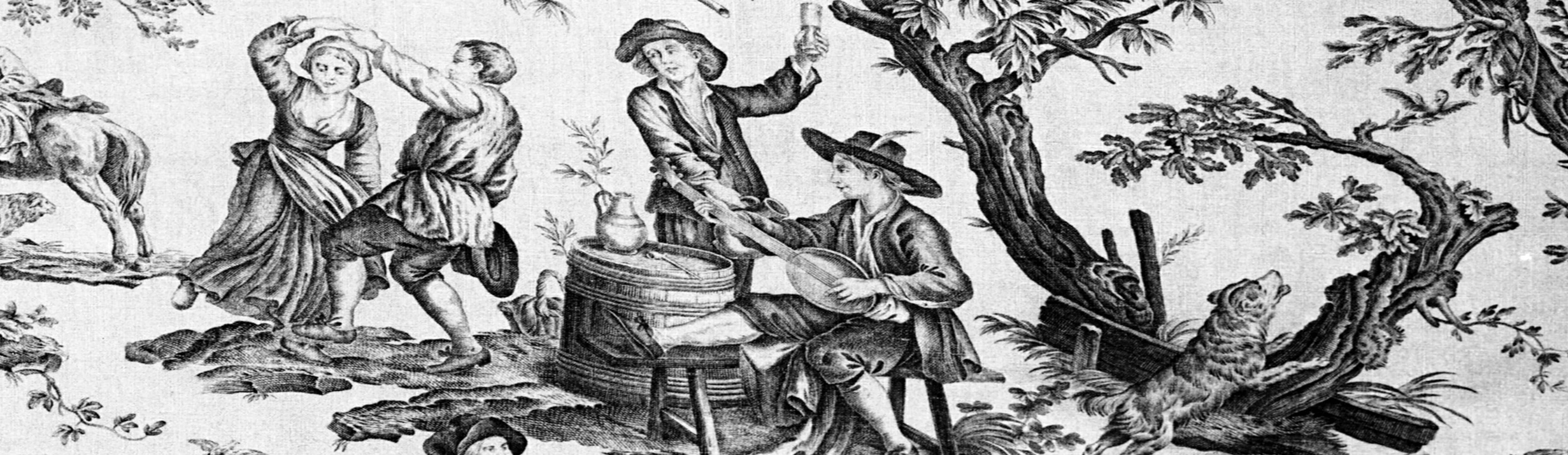
In this Age of Enlightenment, driven by many aspirations, these “images d'Epinal” conveyed an idealized, almost naive vision of rural life. Delicate shepherdesses, romantic encounters under trees, carefree children, farmers hard at work: the countryside depicted on toile de Jouy fabrics seems to be taken from the works of famous painters and engravers (Watteau, Fragonard, Boucher, etc.). Characters and animals are depicted in bucolic landscapes generously adorned with fountains, rivers, and ancient ruins. The harmonious and balanced compositions capture the moment in great detail. Imbued with an undeniable “nostalgia for nature”, these paintings reflect the search for a simpler life, free from pomp and excess. Not only decorative, but also conveying recurring values, these textile patterns remain romantic tributes to the gentle way of life in the countryside.
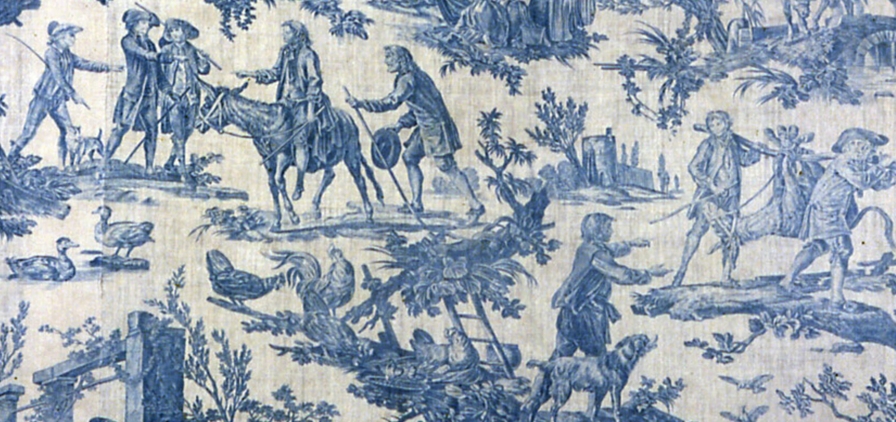 Le manier, son fils, et l’Ane, 1806, Designed by Jean Baptiste Huet, Manufactured by Christophe-Philippe Oberkampf, Jouy-en-Josas, France
Floral seamless patterns: a little-known heritage of Toile de Jouy
Somewhat less well known, but just as important in the history of toile de Jouy, floral patterns were inspired by fabrics from India and Persia that were highly prized in the 18th century. Sometimes stylized, sometimes rendered in a naturalistic and extremely detailed manner, these jumbled plant designs give pride of place to European flowers (roses, peonies, carnations, etc.) as well as exotic varieties. In keeping with the decorative styles of the period, these floral prints are resolutely focused on sophisticated ornamentation and the omnipresence of nature. Their graphic elegance lends itself to a wide range of interior decoration applications (sofas, chairs, curtains, drapes, etc.) as well as clothing.
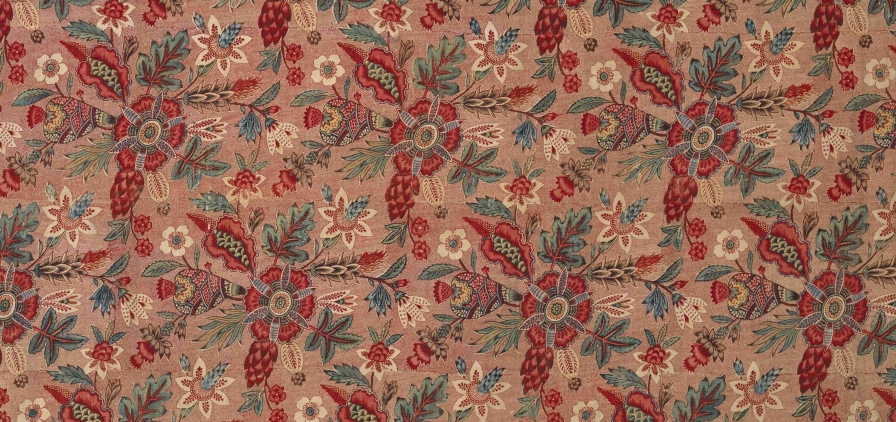 Printed fabric, probably from the Oberkampf factory, late 18th century
Geometric patterns: a graphic touch
Not solely figurative, toile de Jouy also explores geometric seamless patterns, most often in the background of compositions, to balance them and provide visual contrast. Discreet but ever-present, thin stripes, latticework, checkerboards, and diamonds sometimes appear on certain toile de Jouy creations, creating a “graphic diversion” that enhances the harmony between its different elements.
Narrative textile patterns: toile de Jouy as a medium for stories
A remarkable storyteller, toile de Jouy stands out for its narrative textile patterns. These “genre scenes” refer to mythological, literary, historical, and even political episodes. They depict allegories (Liberty, Love, Peace, etc.), significant events (the Montgolfier brothers' flight in 1783), and exotic tales illustrating distant travels and life in the colonies.
Each piece of fabric thus becomes a visual narrative, conveyed through clothing or decoration. The narrative dimension of toile de Jouy made it—and still makes it—a cultural and educational medium as much as a stylistic one. This obvious ability to inform and convey information continues to appeal to artists and designers alike.
The main motifs of toile de Jouy
|
Pattern Type |
Characteristics |
|---|---|
|
Pastoral |
Rural scenes, shepherdesses, animals |
|
Floral |
Stylized or naturalistic flowers |
|
Geometric |
Stripes, lattice patterns, checkerboard backgrounds |
|
Narrative |
Myths, stories, historical episodes |
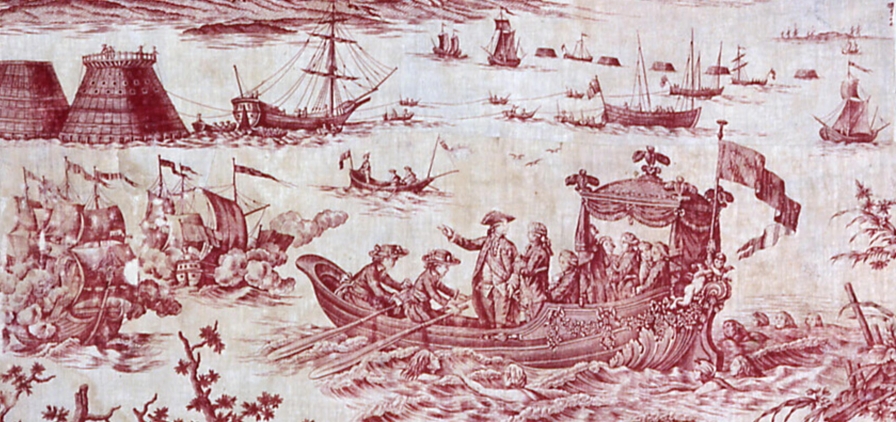 The Inauguration of The Port of Cherbourg by Louis XVI, 1787, Designed by Jean Baptiste Huet , Manufactured by Petitpierre et Cie, Nantes, France
Current use of the toile de Jouy pattern
Toile de Jouy is one of those patterns that retains the same aura over time. Long considered an immutable classic, toile de Jouy has been enjoying a renaissance for several years now. Revisited by stylists, designers, and contemporary decorators, its retro aesthetic has taken on new forms. Colorful, bold, and sometimes humorously or cheekily reinterpreted, it is being rediscovered in interior design, tableware, fashion, children's products, and stationery.
The toile de Jouy pattern in fashion
Toile de Jouy has a long history in fashion. Several major fashion houses have made it a signature feature of their collections and regularly bring it back into style. Dior, to name just one, has been using it in its various collections and reinterpreting it since the 1950s, playing with colors, materials, and scales. More recently, certain designers have redirected attention to this essential pattern. The originality of their work has led to several collaborations with famous labels and major brands (Bloomingdale's, Converse, Christian Lacroix, Opening Ceremony, etc.).
One example is Richard Saja's embroidered fabrics, which rework the looks of classic toile de Jouy characters with a needle and thread, transforming them into punk rockers with mohawks, clowns with wigs, or colorful, hairy yetis. Or the “Harlem toile de Jouy” concept by Sheila Bridges, who boldly reworks traditional scenes to highlight African-American stereotypes.
Today, the codes of luxury, nostalgia, and graphic innovation come together and merge without any inhibitions, in a refreshing mix of genres. Whether traditional or freestyle, rural settings and pastoral scenes are illustrated in a relaxed manner on dresses, jackets, bags, and even sneakers, creating a very trendy visual contrast.
The toile de Jouy pattern in interior design
In interior design, toile de Jouy breaks free from certain conventions while retaining its elegance. An asset of charm and good taste, it is naturally found in classic settings, but it also fits into contemporary atmospheres with much more audacity. Playing with scale, XXL formats, metallic versions, inverted patterns, black or colored backgrounds: anything goes!
Freed from its “stiff” appearance, toile de Jouy plays on eclecticism and contrast by blending tradition and modernity, while remaining a strong decorative element. As diverse as ever, its applications range from wallpaper to curtains, cushions, bed linen, tableware, and seat covers.
With much more freedom: beyond wood and gilding, it now offers new possibilities and blends harmoniously with contemporary materials such as concrete, glass, and steel.
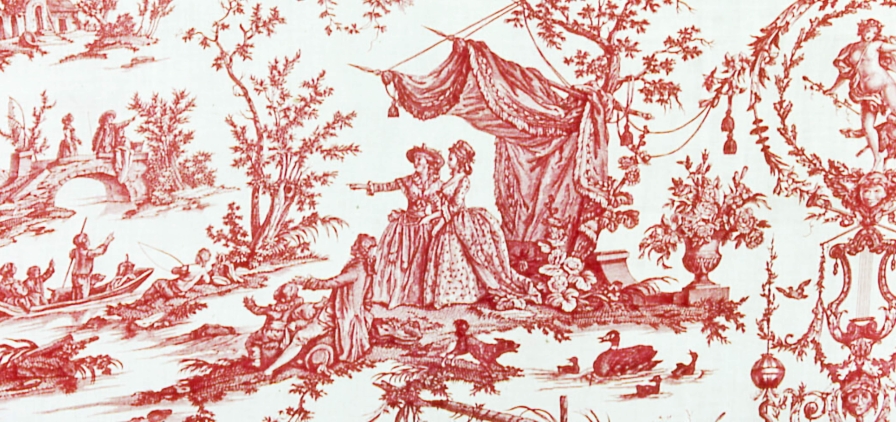 L’Abreuvoir ,1796/97, Designed by Jean Baptiste Huet, Manufactured by Christophe-Philippe Oberkampf , Jouy-en-Josas, France
Houses that preserve the tradition of toile de Jouy
La Maison Thévenon: Ludivine toile de Jouy
La Maison Thévenon, a major player in French furnishing textiles, plays an essential role in the contemporary continuity of toile de Jouy. For over a century, Thévenon has been developing family expertise passed down from generation to generation, and it is in this demanding context that the famous Ludivine toile was born.
The Ludivine fabric is directly in line with the visual heritage of the historic fabric, while representing a resolutely contemporary reinterpretation. Introduced in 2004, the Ludivine pattern depicts a dreamy young lady perched on her swing. This soft and poetic composition echoes the narrative logic of toile de Jouy: it tells a story while remaining decorative. Its style perfectly illustrates how Thevenon manages to respect the spirit of a historical design while adapting it to contemporary tastes.
It is through the multiple colors of the Ludivine toile de Jouy that Thevenon affirms its contemporary reinterpretation of the seamless pattern. Ludivine is available in fuchsia pink on an orange, red, or camel background. This gradual evolution of colors illustrates Thevenon's ability to bring the Ludivine textile pattern to life over time, adapting it to current trends without ever betraying the poetry or spirit of the original toile de Jouy.
Maison Charles Burger: Robinson Crusoe toile de Jouy
Alongside Thevenon, Maison Charles Burger is another major pillar in the preservation and reinterpretation of toile de Jouy. Since the 19th century, Charles Burger has built up an exceptionally rich archive collection. This company, one of the last two custodians of Oberkampf's copper rolls, plays a key role in continuing the Jouy style while offering strong and inspired creations, of which the Robinson Crusoe toile de Jouy is an emblematic example.
Illustrating the adventures of Robinson Crusoe, the fabric designed by Maison Charles Burger faithfully captures the narrative spirit of the historic fabrics. Based on Daniel Defoe's novel of the same name, the Robinson Crusoe pattern depicts iconic episodes from the story. Available in several colors, this narrative textile design invites you on a journey, just as the pastoral or mythological scenes of the original fabrics did.
FAQ: everything you need to know about toile de Jouy
1. Does toile de Jouy always feature pastoral scenes?
No. Although pastoral imagery is the most well-known today, it represents only a small part of historical production. Of the thousands of designs created by Oberkampf, only about 650 scenes are actually pastoral. The majority of fabrics were actually floral or geometric.
2. What type of fabric is used to make toile de Jouy?
Traditionally, toile de Jouy is printed on white or ecru cotton fabric, but there are many variations depending on the period and use. Printing was done in one color, and sometimes in several.
3. How was it decided whether a pattern would be used for fashion or decoration?
Historically, it was the size of the pattern that dictated its use.
- A small-scale pattern was intended for clothing.
- A large-scale pattern was used more for furnishings.
4. Why are narrative textile pattern most commonly associated with toile de Jouy today?
Narrative fabrics have survived the centuries because they were often preserved as cultural documents. Their ability to tell stories related to mythology, literature, or history gave them lasting value, unlike certain floral seamless pattern that were less well preserved.
5. Why do we recognize toile de Jouy even without knowing its name?
The typical scenes—bucolic landscapes, characters, ancient architecture—have a very strong visual identity. As Marie Olivier of the Musée de la Toile de Jouy explains, even without knowing Oberkampf or the term “toile de Jouy,” the patterns are immediately recognizable.
6. How much does toile de Jouy-style printed fabric cost?
The price depends on the manufacturer, the weight, and the type of fabric.