










Landscape textile patterns
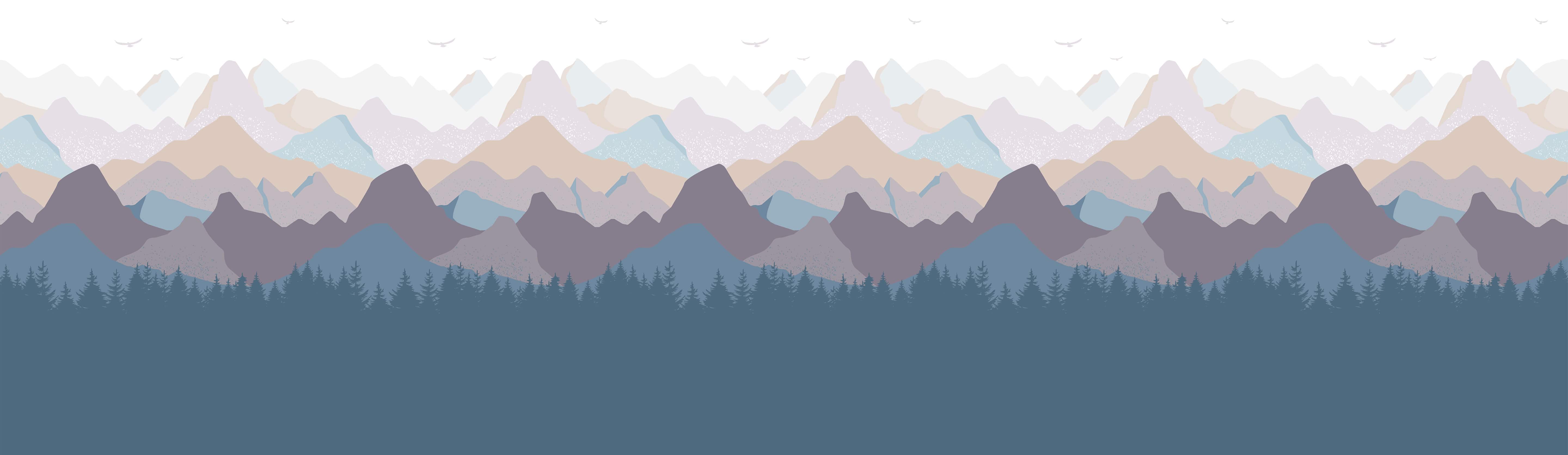
Landscape textile patterns can tell a story, evoke a memory, convey a feeling... Both rooted in trends and conveyors of emotions, they transform our clothes and interiors into veritable postcards. With their place becoming increasingly prominent in current trends, landscape patterns seem to have a bright future ahead of them!
Textile patterns of natural landscapes
In certain regions of the world (South America, Asia, etc.), textile crafts have long favored landscape designs. Characterized by stylistic unity and consistency, these representations generally adhere to traditional codes. The natural landscapes of a given region appear in the form of colorful geometric symbols, through which everyone can instantly identify a mountain range, a river, a valley, or a seashore.
In fashion and interior design, nature is making its presence felt more than ever in textile patterns, no doubt in response to our need to escape, contemplate, and reconnect with what matters most. Dense forests, idyllic beaches, and majestic mountains continue to inspire us as much as ever, if not more so. These universal themes regularly take center stage, particularly in clothing.
Fields of wildflowers, misty forests, and rolling waves appear in the form of abstract or realistic prints. In interior design, these fascinating landscapes are displayed on sheer curtains, cushion covers, and wall hangings to create a Zen garden atmosphere or suggest a getaway along the coast. Color plays a fundamental role in these compositions. To enhance this aesthetic serenity, soft shades are generally used, directly inspired by nature, in shades of blue, navy, and cerulean, fresh or deep greens, warm ochres, sandy beiges, and earthy browns.
These landscape surface patterns are also characterized by a wide variety of styles ranging from ultra-realism (particularly thanks to digital printing) to free interpretations, sometimes highly stylized or even totally conceptual, of barely suggested panoramas.
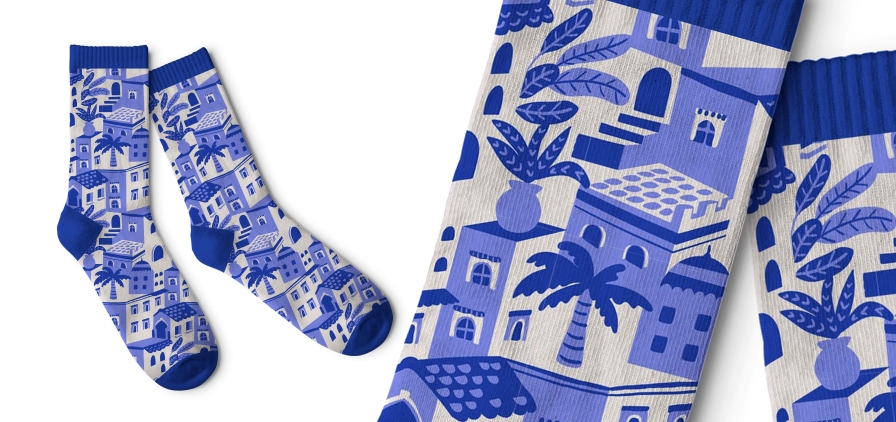 Surface pattern "Chefchaouen" designed for the Textile Addict 2025 competition by Audrey Medy, textile designer on French Design by Textile Addict
Textile patterns of urban landscapes
Entirely shaped by humans, architectural structures, geometric lines, and complex visual dynamics have made cities very rich environments from a graphic point of view. In the world's major metropolises, there is a cosmopolitan energy and a form of avant-garde aesthetics that designers are quick to translate into contemporary textile patterns.
Urban photography is an inexhaustible source of inspiration for creatives, whether they are depicting skyscrapers or crowded streets, sculptural bridges, iconic facades, or unexpected perspectives.
Unlike natural landscapes, these urban images with their sharp, marked contrasts benefit from being treated in a highly structured way, with the use of angular shapes outlined by clean lines. Combined with collage, superimposition, fragmentation, and pixelation effects, these compositions reflect the frenzy and sense of visual acceleration characteristic of contemporary cities. The use of cool, muted colors (asphalt, concrete, steel, etc.) is systematic, punctuated with brighter touches evoking signs, neon lights, or reflections in windows to enliven the setting and further reinforce the sensation of speed.
In streetwear as in haute couture, urban landscape prints embody an aesthetic vision of the city. The theme is often approached in an underground spirit, not necessarily to pay homage to urban environments, but also to question and cast a critical eye on them. In interior design, these panoramas are prized for emphasizing industrial atmospheres, particularly in lofts and open spaces.
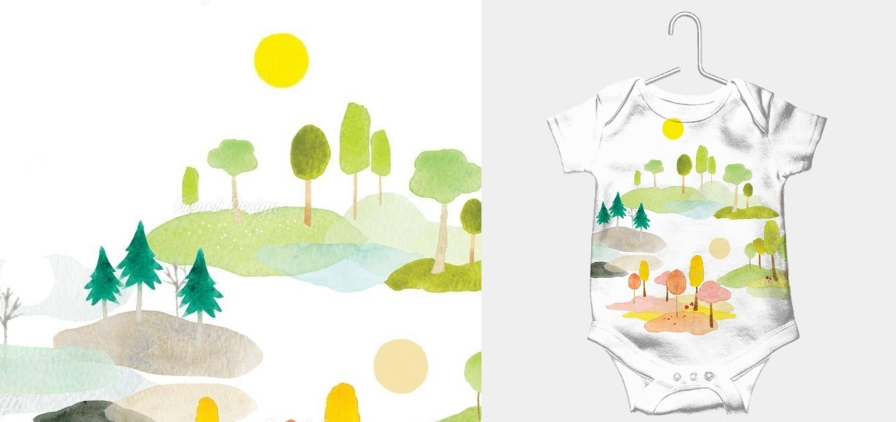 Surface pattern "Saisons" designed by Anh Mai Studio, textile designer on French Design by Textile Addict
Landscape textile patterns: trends in fashion and interior design
Their ability to evoke immediate emotion by “telling the story” of a place, a journey, or a dream of escape makes landscape designs a key element in current trends. In search of well-being and personal fulfillment, the public aspires to engage with strong visual identities in order to better connect with them.
In fashion, this textile design trend has not escaped the attention of the major fashion houses, which are delivering their own versions of classic or futuristic landscapes, enhanced in the form of printed statement pieces. Bringing together the past and the present is a recurring theme that allows designers to revisit romantic textile patterns inspired by old engravings or master paintings. More understated and accessible, ready-to-wear fashion prefers to play with landscapes linked to photography and the digital world.
In interior design, the slow life philosophy has become the common thread running through the most “natural” trends, bringing seamless patterns inspired by nature to the forefront. It is not uncommon for inspiration to come from “elsewhere,” from a specific lifestyle (Scandinavian, Japanese, Wabi sabi or Japandi, etc.) or from major movements such as Art Deco, for example. These trends naturally encourage the use of landscapes as decorative elements in their own right, often central to environments designed to soothe, comfort, and inspire. Landscape textile patterns can then become a medium for personal expression, allowing us to display, as we wish, a travel memory, a tribute to our roots, our region of origin, and more.
Our visual environment is a constant source of wonder. The desire to bring the beauty of the world into our daily lives seems to be growing, even among the least contemplative minds! Creative types, for their part, still seem to enjoy looking at landscapes in order to offer their own interpretation, whether abstract, ultra-realistic, poetic, or completely dreamlike. Landscape patterns are therefore far from finished embellishing our daily lives: they will continue to touch us and take us on a journey with a simple glance for a long time to come!